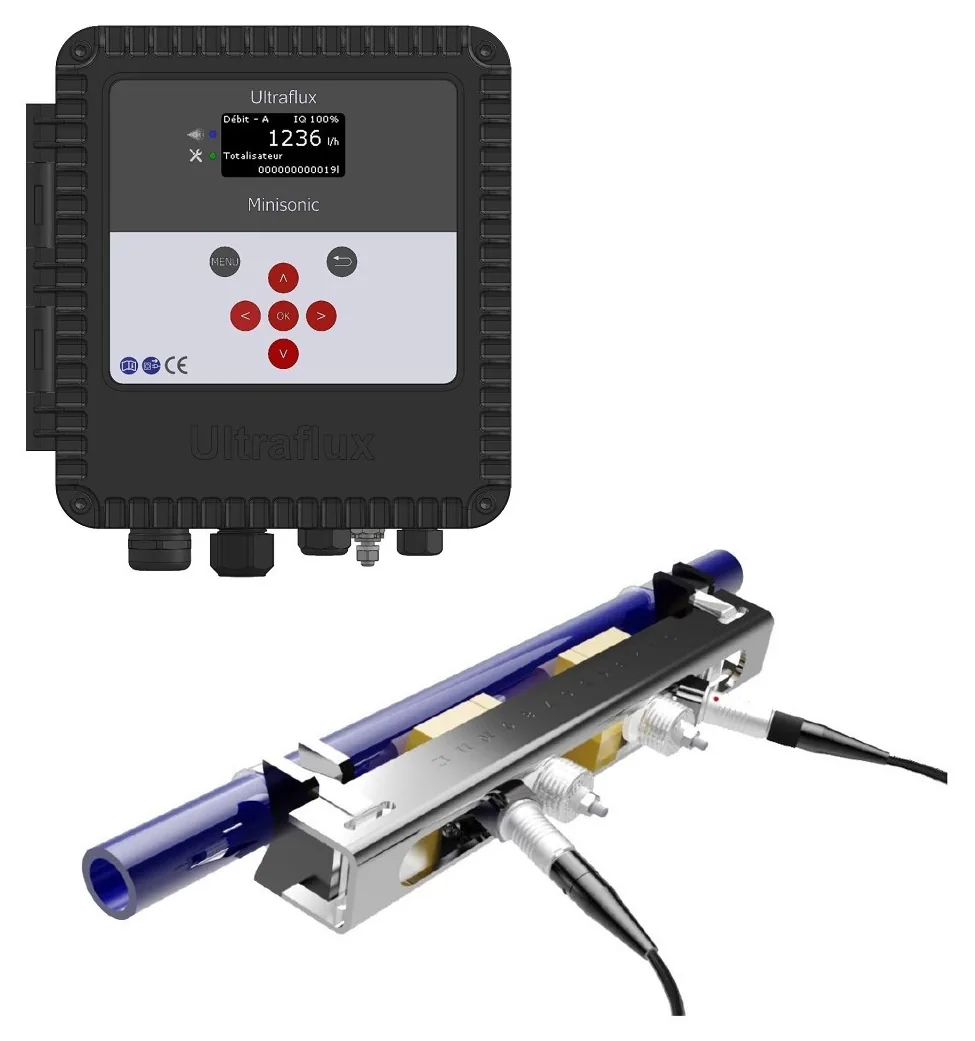
A permanent clamp-on ultrasonic flow meter for water, acids, alkalis and chemicals. 0.5% of reading, IP67, with isolated 4–20 mA and Modbus TCP into your control system.
SKU SZMINI600A · FROM $7,650
One pipe, continuously, into a control system — and the fluid would eat a wetted meter.
This instrument exists because of a specific, recurring, expensive situation: you need continuous flow measurement on a line carrying something that destroys flow meters.
Sulfuric acid. Sodium hydroxide. Sodium hypochlorite. Ferric chloride. Solvents. Put a wetted meter in that stream and you have started a clock. The sensor corrodes, the liner degrades, the electrodes foul — and when a wetted meter fails on an acid line it does not just stop reading, it becomes a leak path for a fluid you very much do not want on the floor.
A clamp-on transmitter sits on the outside. Nothing in the stream to corrode. No gasket to fail, no flange to weep, no electrode to foul. Chemically, the instrument does not know what is in the pipe.
Read that spec carefully. A meter quoted as a percentage of full scale gets proportionally worse as flow drops — at 10% of range, a 0.5%-FS meter is 5% off the reading. Percent-of-reading holds its accuracy across the turndown. It matters most at exactly the flows you care about.
The OLED shows measurement echo, gain and quality index. On a permanent installation, trend the gain. Gain creeping upward over months is your early warning that the couplant is degrading — the transmitter is compensating for a weakening signal before the reading itself visibly fails. Catch it there and the fix is a re-coupling. Miss it and the meter goes from “fine” to “dropped out” with no warning, usually on a Friday.
The 4–20 mA output and the contacts are isolated. Use them as such. A non-isolated analog output on a long run in an industrial environment is a ground loop waiting to happen, and the symptom is a reading that wanders in a way nobody can explain.
| Technology | Ultrasonic transit-time, clamp-on (non-invasive) |
|---|---|
| Pipe size range | DN15 – DN630 (transmitter supports up to 10,000 mm) |
| Pipe materials | Plastic, cast iron, galvanized iron, stainless steel, PVC, PPR, GRE, GRP |
| Fluids | Water, acids, alkalis, chemicals |
| Accuracy | Up to 0.5% of flow reading |
| Repeatability | Up to 0.1% |
| Calibration | On-site zero-point automatic calibration |
| Measurement rate | 10 flow calculations per second |
| Measured values | Volumetric flow rate, velocity, speed of sound, totalizers, signal quality, gain, transit time |
| Display | OLED graphic display, 128 × 64 pixels — shows measurement echo, gain, and quality index |
| Outputs | 1× isolated 4–20 mA, 2× isolated contact outputs |
| Communication | Modbus TCP over Ethernet; USB for firmware update and logger download |
| Data logging | Multi-parameter data logger |
| Filters | Damping time, memory time, low-flow cut-off |
| Power supply | 110–230 VAC 50/60 Hz (6 W average, 10 W peak) |
| Enclosure | Molded polycarbonate with 30% glass fiber |
| Protection | EN/IEC 60659 IP67 |
| Operating temperature | −20 °C to +60 °C |
| Compliance | EMC: EN/IEC 61326-1 |
| Weight | 23 kg |
| Dimensions | 12 × 24 × 35 cm |
| Maintenance | No moving parts, no fluid contact — no wear, no recalibration drift |
Specifications transcribed from the manufacturer datasheet and subject to change. Confirm against the controlling document before specifying — Seztec will send it to you on request.
This instrument is specified into the following industries. Each page covers the specific measurement problems, the fluids involved, and what usually goes wrong.
Send us pipe size, pipe material, wall thickness, lining, fluid, and how much straight run you have. A Seztec application engineer will confirm the fit — or tell you it is the wrong instrument, which happens and which we would rather say before you buy.
Request a quote